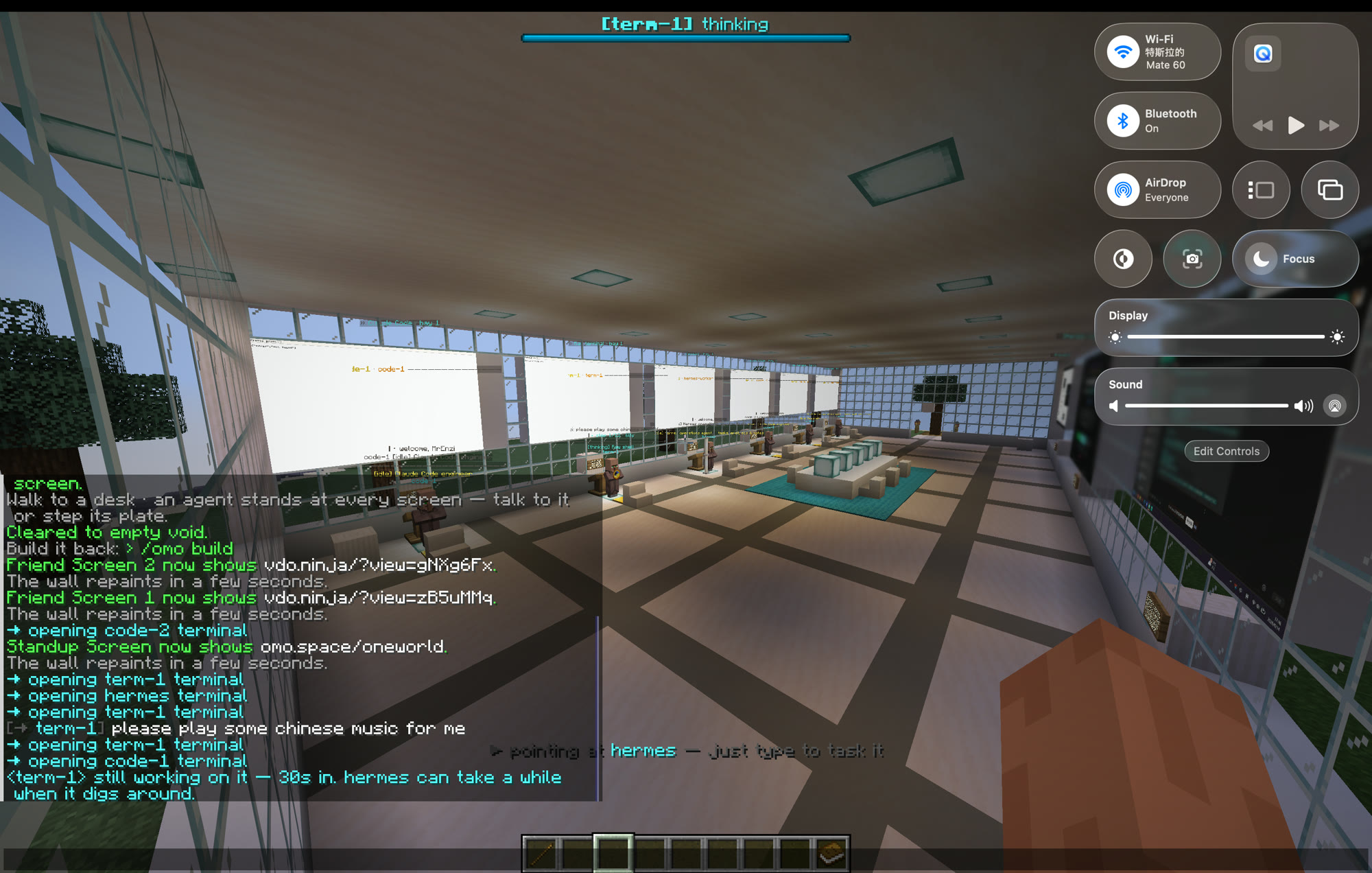
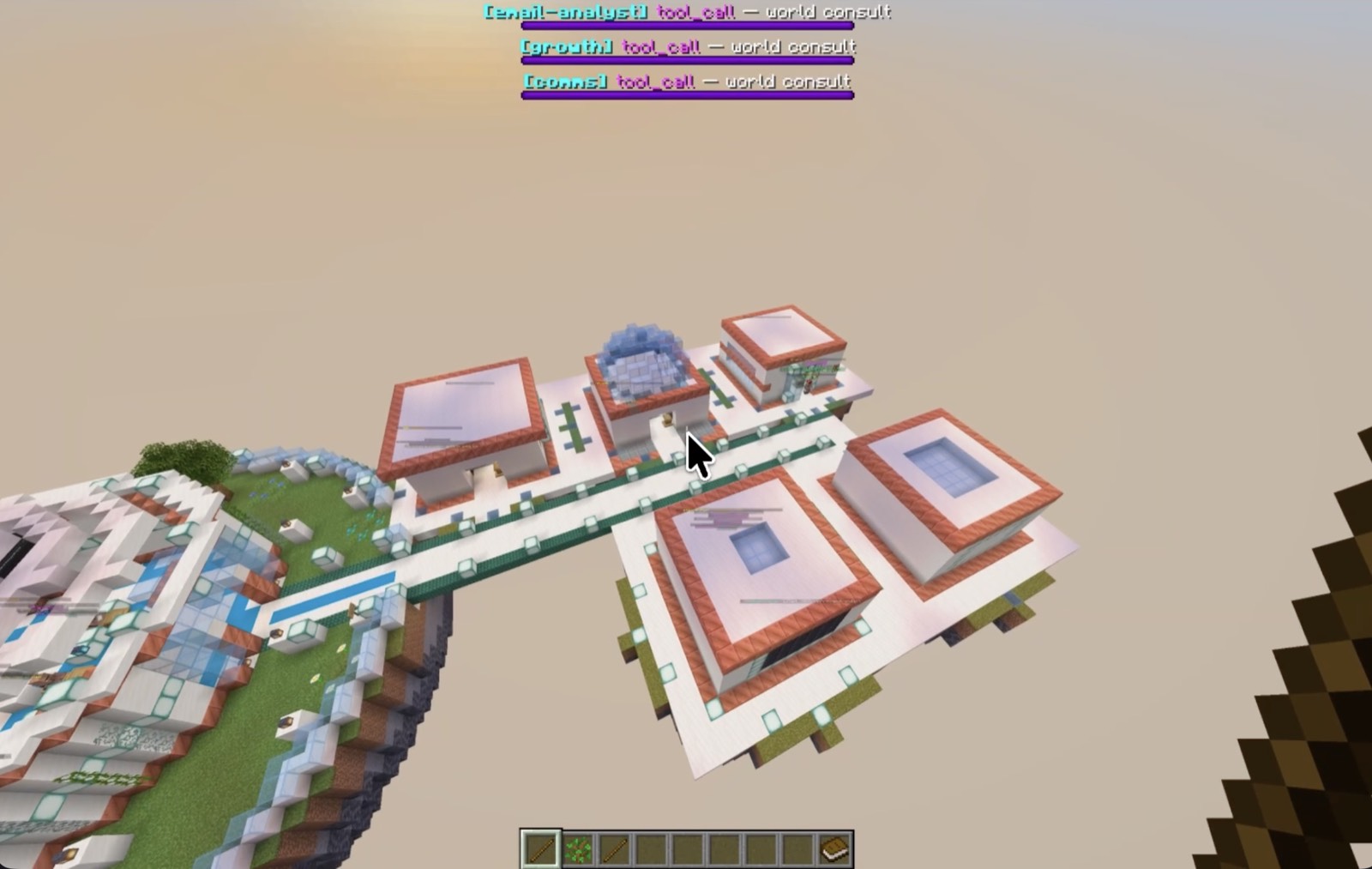
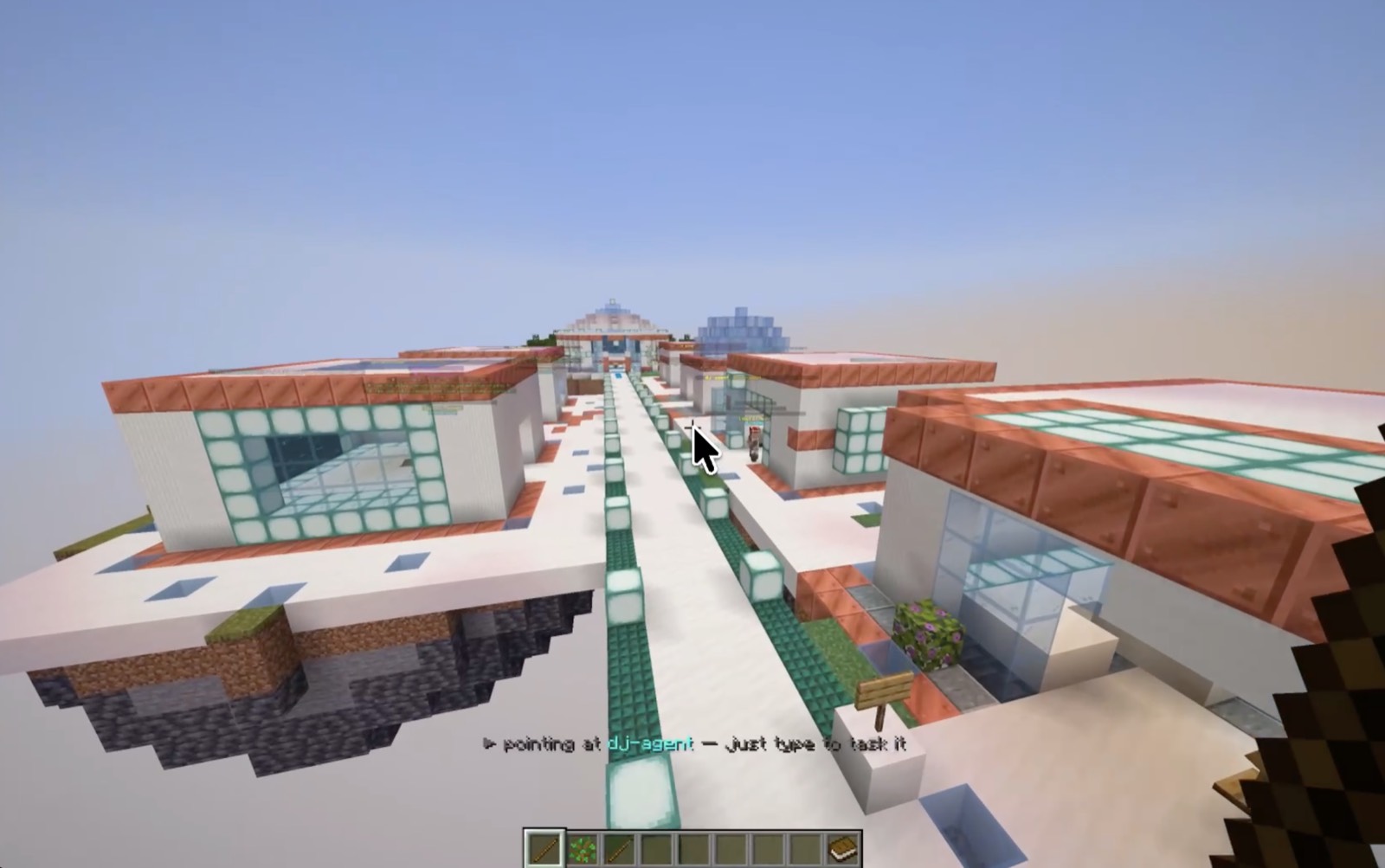
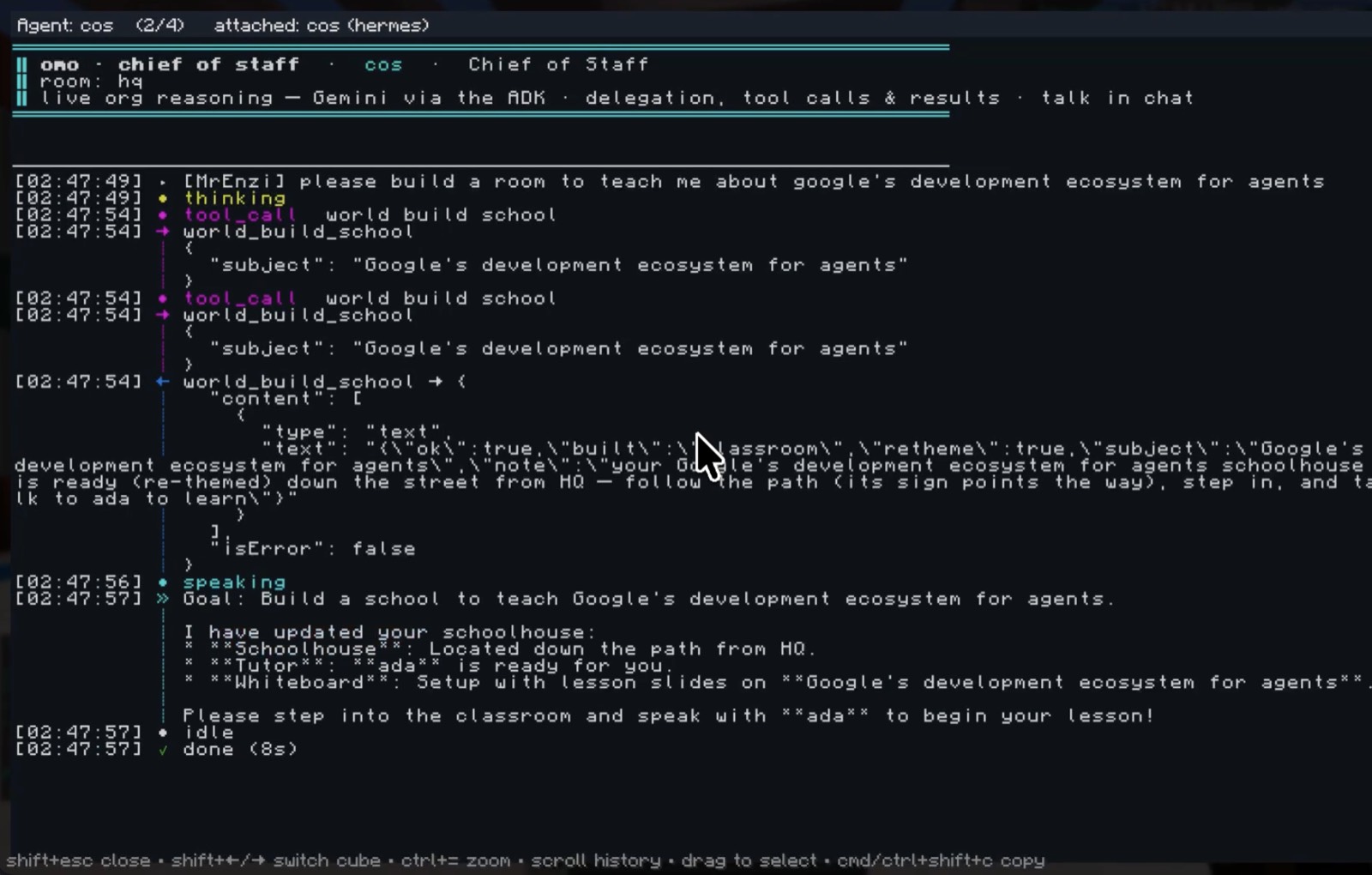
⛏ Vanilla Minecraft🖥 One shared computer◆ Claude Code + Hermes
LIVE · real Minecraft world
// one world · one shared computer · walls that are live screens — your whole team builds on it together.
agentjam.omo.space
▸ AgentJam — multiplayer vibecoding · one shared computer · no git, ever
3/3 playing 0 conflicts · join ▸
SEE A JAM IN MOTION
Two coders. One computer. Watch them build at once.
LIVE · multiplayer coding
REAL FOOTAGE — NO MOCK-UP — two teammates inside one Minecraft world, coding on the same shared computer at the same second. No screen-share, no branches: they're literally standing in the same place. Hit play with sound.
THE WHOLE TRICK, IN ONE PICTURE
One computer. Everybody's hands on it at once.
Here's the secret. There aren't ten laptops, each hiding its own copy of the code that someone has to
stitch back together later. There's one powerful computer — and your whole
team reaches into it together, inside one Minecraft world.
You walk up to a screen and open Claude Code. Your friend walks up and
opens the same Claude Code. Same Hermes agent. Same terminal. Same web
browser. It's all one computer — so there's nothing to sync, nothing to merge, and never two versions
fighting. You're not mailing files back and forth. You're just in there together.
LIVE · real screen recording
THIS IS REAL — NO MOCK-UP — inside the world, every wall is a live screen wired to the one
shared computer. Talk to it, type a URL, watch it repaint. Hit play and unmute for the full jam.
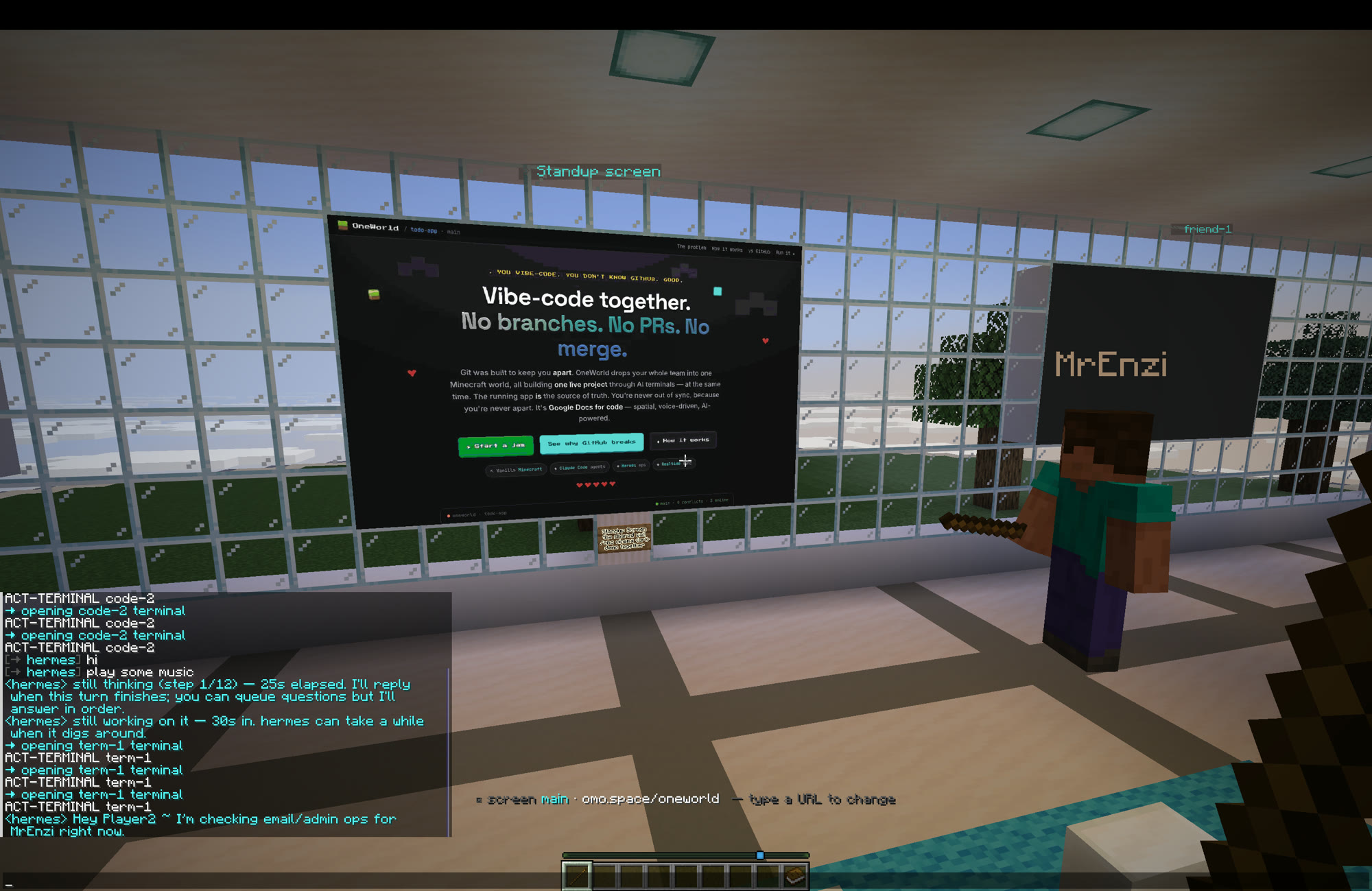
THIS VERY PAGE, ON THE WALL — the screens aren't decoration; they're real, running surfaces. Type a URL and the wall repaints for everyone in the world at once.
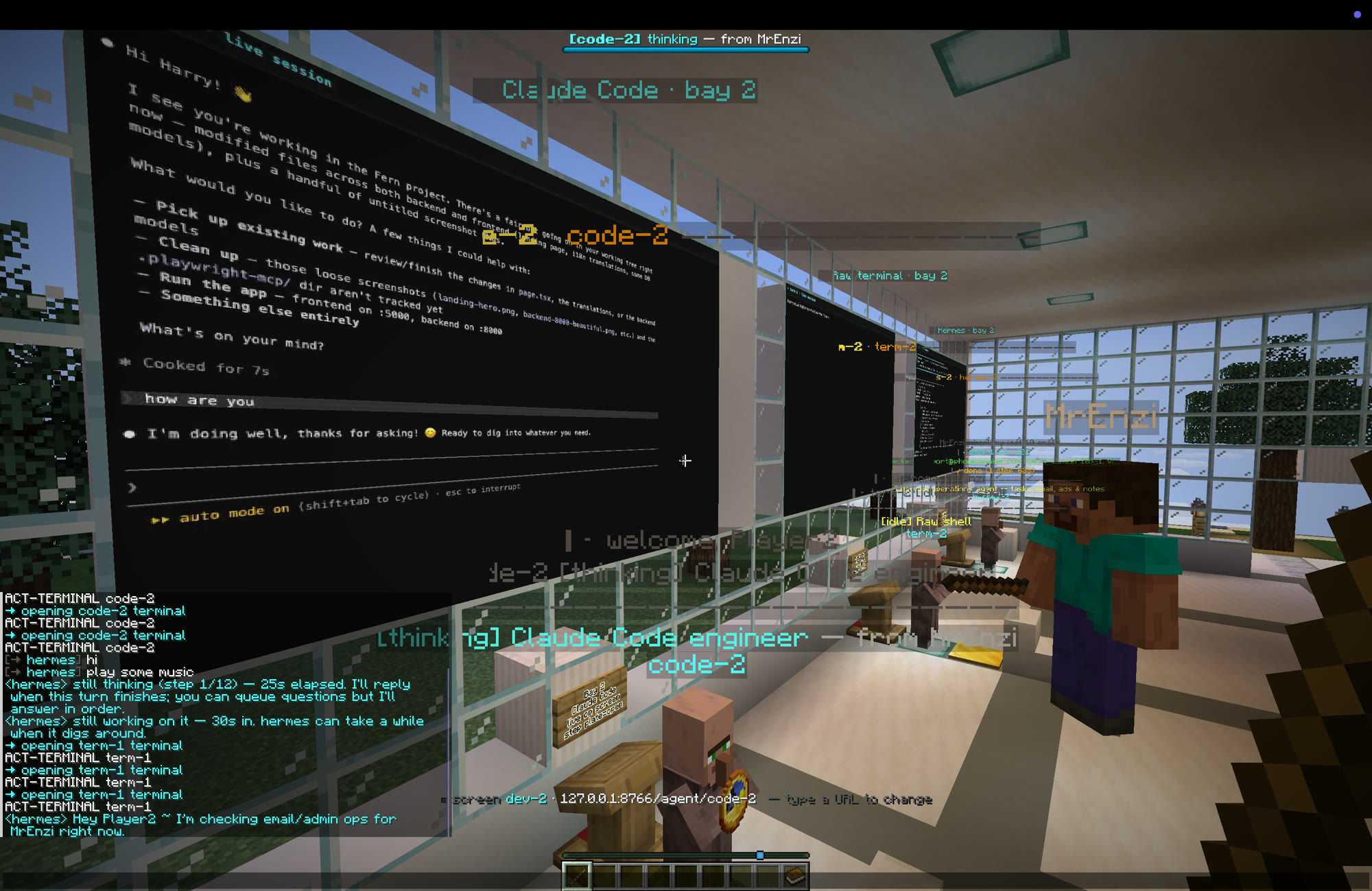
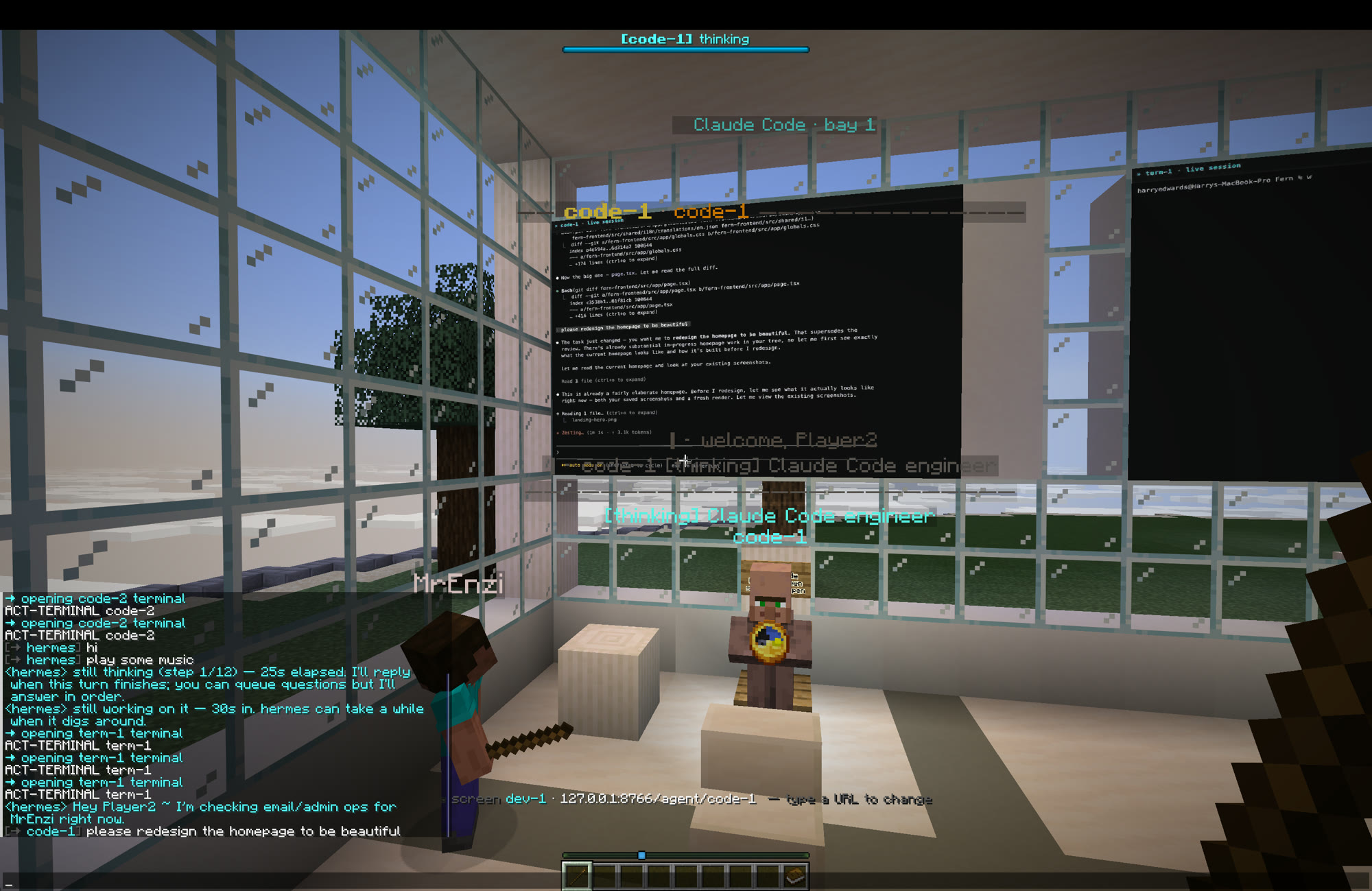
AGENTS CODING, LIVE — talk to your agent and watch it edit the one shared project on the wall, in realtime, right next to your teammates.
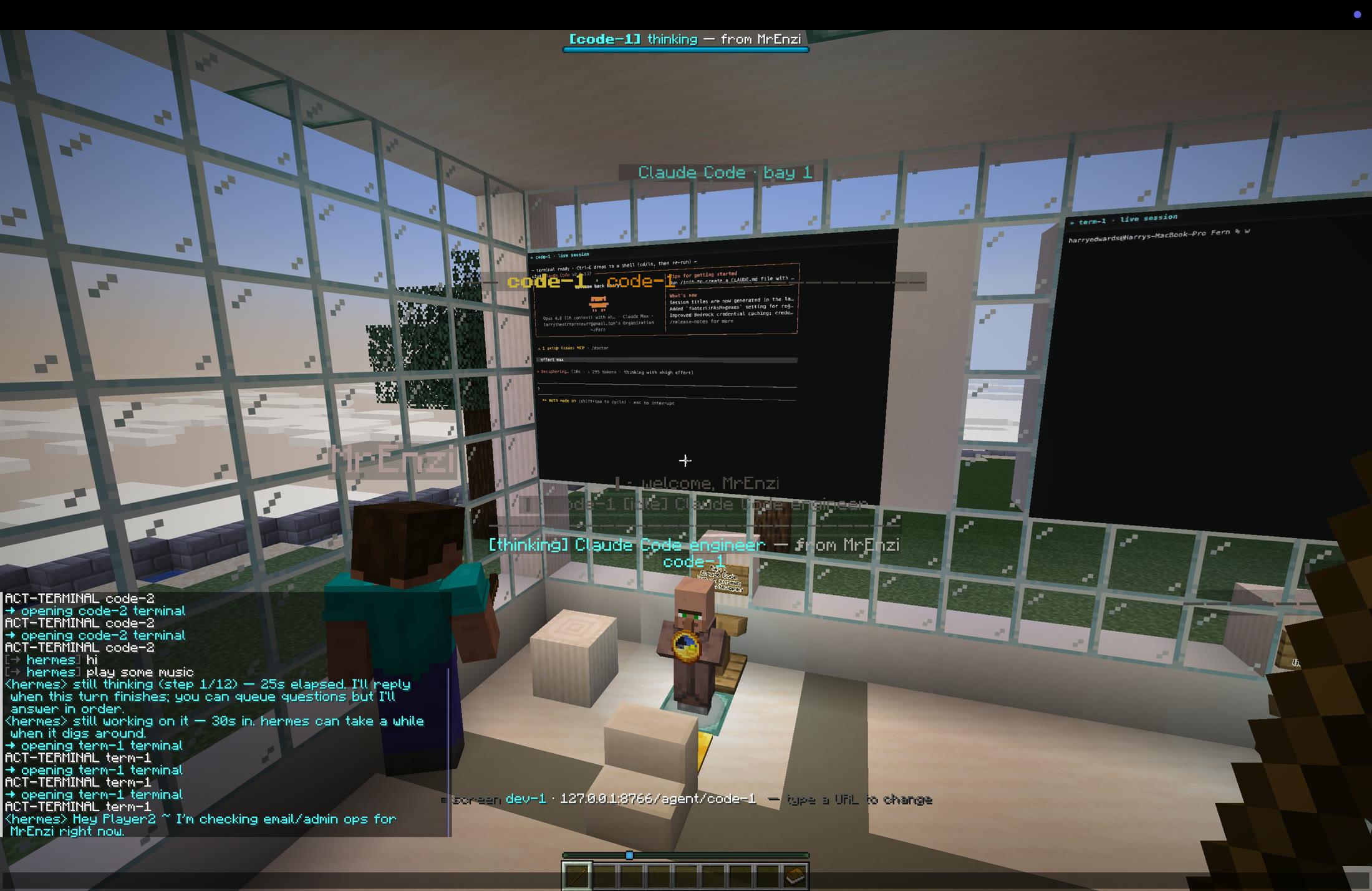
ONE ROOM, EVERY SCREEN LIVE — terminals, agents and browsers, all driven by the one shared computer. Walk between them like desks in a studio.
THE WHOLE TEAM, ONE WORLD — no forks, no clones, no "my version." One place, one project, everyone building it at the same time.
Walk up to any screen and open any of these — the
same ones your teammates can open, all on the same computer:
◆ Claude Code
The AI coder. Say what you want out loud; watch it build straight into the shared project.
✦ Hermes agent
Your ops & voice agent — email, errands, the busywork — handled while you keep building.
▸ Raw terminal
A real shell, no agent in the way. Run anything yourself, like you're sitting at the machine.
🌐 Web browser
The live site, the docs, anything on the web — right there on the wall, shared with the room.
▸ deploy it anywhere
Stand up one AgentJam computer for your whole company — every team that joins the world shares it — or
just spin one up with friends from a laptop on a Saturday. Same idea either way: one computer, everyone on it.
THE THING NOBODY SAYS OUT LOUD
GitHub was built for people who'd never be in the same room.
Branch. Push. Pull. Fetch. Rebase. Stash. Open a PR. Request review. Resolve conflicts.
Every one of those words exists for a single reason: you and your
teammate aren't in the same place at the same time. It's an entire machine built to paper over distance.
the problem, animated
TODAY — two coders, two branches, no clue what the other touched. Each alone in their own copy, talking past each other in the dark. A branch is just a wall you can't see over.
And when you're vibe-coding — three people in a room, AI agents firing out code by
the second, a new idea landing every minute — that machine doesn't protect you. It stands
in your way. You move at the speed of conversation; git makes you stop, ceremony-up, and wait.
A merge conflict is just git admitting two people had the same
idea at the same time — and it couldn't hold both. So one of you stops building to play referee.
#247 Add remember-me to login
opened 3 days ago by ben · main ← feature/remember-me
⚠ 2 conflicts0 reviewswaiting…
The change was done three days ago. It's still sitting in a
branch, behind a review nobody's opened, behind a conflict nobody wants. The
work is finished. The friction isn't.
THE TAX YOU PAY TO "COLLABORATE"
None of this is building. It's the cost of being apart.
⌛ Waiting for review
The code is ready. It ships when someone happens to click. Momentum dies in the queue.
⚔ Resolving conflicts
You stop building to hand-merge two versions of the same idea, line by line.
🪞 Drifting copies
Your machine, my machine, the branch, the remote. Four "truths," none of them in sync.
🔌 "Works on my branch"
It ran for you. It won't for me. Nobody can see the one thing that's actually running.
🧩 Context-switching
Flow, then stash, then rebase, then flow again — if you can find your way back.
📨 Pinging for a merge
"can you approve #247?" The whole team is online. You're still messaging about a button.
▸ A MOMENT OF SILENCE FOR YOUR BRANCHES
Be honest. Nobody actually likes GitHub.
We just learned to live with it — like a roommate who keeps
"tidying" your code into branches you'll never see again, and a chat box that says fatal:
at you like that's a normal way to speak to a human being.
🔍how to undo git ▍
how to undo git commit
how to undo git commit without losing my changes
git merge conflict help please
what is detached HEAD state am i ok
git push --force accidentally how to recover
delete .git folder and start over is this safe
your search history, last 30 days. be honest — you've typed at least four of these.
AgentJam has zero of those searches.
Not because we fixed them — because none of it exists to fix.
git — a horror story in 6 commands
$ git status # everything is fine$ git pull # everything is no longer fine CONFLICT (content): Merge conflict in literally everything$ git merge --abort # pretend it never happened$ git reset --hard HEAD # scorched earth$ git reflog # what have i done$ rm -rf project && git clone // the only known cure ✨
Scarier than a creeper at 2 a.m.: git rebase -i on a Friday.
"I haven't resolved a merge conflict in three weeks. My therapist says I seem lighter."
— Ana, recovering git user
"My deploy strategy used to be git push --force and prayer. Mostly prayer."
— Ben, no longer praying
"I named a branch final-FINAL-v2-actually-final. AgentJam took that pain away."
— Cy, one branch fewer
* Testimonials dramatized. The merge conflicts were real.
THE BIG IDEA — HERE'S THE WHOLE TRICK
So we deleted the distance.
Put the whole team on one computer, inside one world. One live project,
running right there. Everyone's AI agents edit the same files, live. There's no
"your copy" and "my copy." There's one machine everyone's on — and what's on it is the truth.
ONE WORLD, EVERYONE IN IT — no forks, no clones, no "my version." One place, one project, the whole team building it at the same time.
▸ the unique mechanismNo branch to merge, because nobody ever left main.
No PR to review, because review is just walking over and watching it happen.
No conflict to resolve, because you were never out of sync to begin with. You don't reconcile
two versions — there was only ever one.
It's not "better Git." It's no Git in the
loop at all — the way Google Docs isn't a better way to email documents back and forth. You're just…
in the same doc. Except the doc is a running app, and the cursors are your teammates, standing next to you.
★ for everyone who never learned the dance
So you vibe-code and you've never really learned git. No rebases, no reflog, no untangling a detached
HEAD at midnight. Here's the secret nobody tells you: that's not a gap to fix — it's a head start.
The entire ceremony you skipped is the exact ceremony AgentJam deletes. You're not behind. You're early.
HOW A JAM ACTUALLY RUNS — FIVE MOVES
One world. One project. Everyone, right now.
1
Everyone joins one world.
The team loads into a single Minecraft server. No repo to clone, no branch to check out — you walk in and you're already there.
2
You all share one computer.
One powerful machine runs the whole world — one codebase, one running app. The wall is that computer's screen, shared with everyone — what you see is what's live, this second. No copies to keep in step.
3
You get your own station.
Four surfaces, all wired to that one computer: a Claude Code agent + its screen, a raw terminal (a real shell, no agent in the way), a Hermes ops agent + screen, and a web browser on the wall. They're the same surfaces your teammates open — you talk, it codes, into the one shared project.
4
Changes appear in realtime.
You review by walking over, watching, and talking — not by opening a PR. A teammate's edit lands in front of you the moment it happens. This is the genuinely new piece: the same files, live, like Google Docs multi-cursor.
5
The world auto-saves.
Undo and history without anyone running git. Auto-snapshots replace commits — so you get the safety net, none of the ceremony.
REVIEW = WALK OVER — no PR, no queue. Stroll to a teammate's station, watch the build land, and talk. That's the whole review.
YOUR SCREEN, LIVE — talk to your agent; watch it edit the one shared project in realtime, right there on the wall.
Five moves. Zero pull requests. Nobody pushed, nobody pulled, nobody merged — and the
whole team shipped the same app together.
YOUR STATION
Four surfaces. One computer. You turn to a teammate by looking over.
Every station is just a window into the same computer. You drive your
own agents and your own shell — so two people never fight over one keyboard — while all of you build the
one shared live project. Open Claude Code, and it's the same Claude Code
your teammate can open.
◆ what's on your desk1× Claude Code agent + screen — your coder, with a live view of what it's doing. 1× raw terminal — a real shell; run anything yourself. 1× Hermes agent + screen — your ops/voice agent. A web browser — the live site & the web, on the wall, shared with the room.
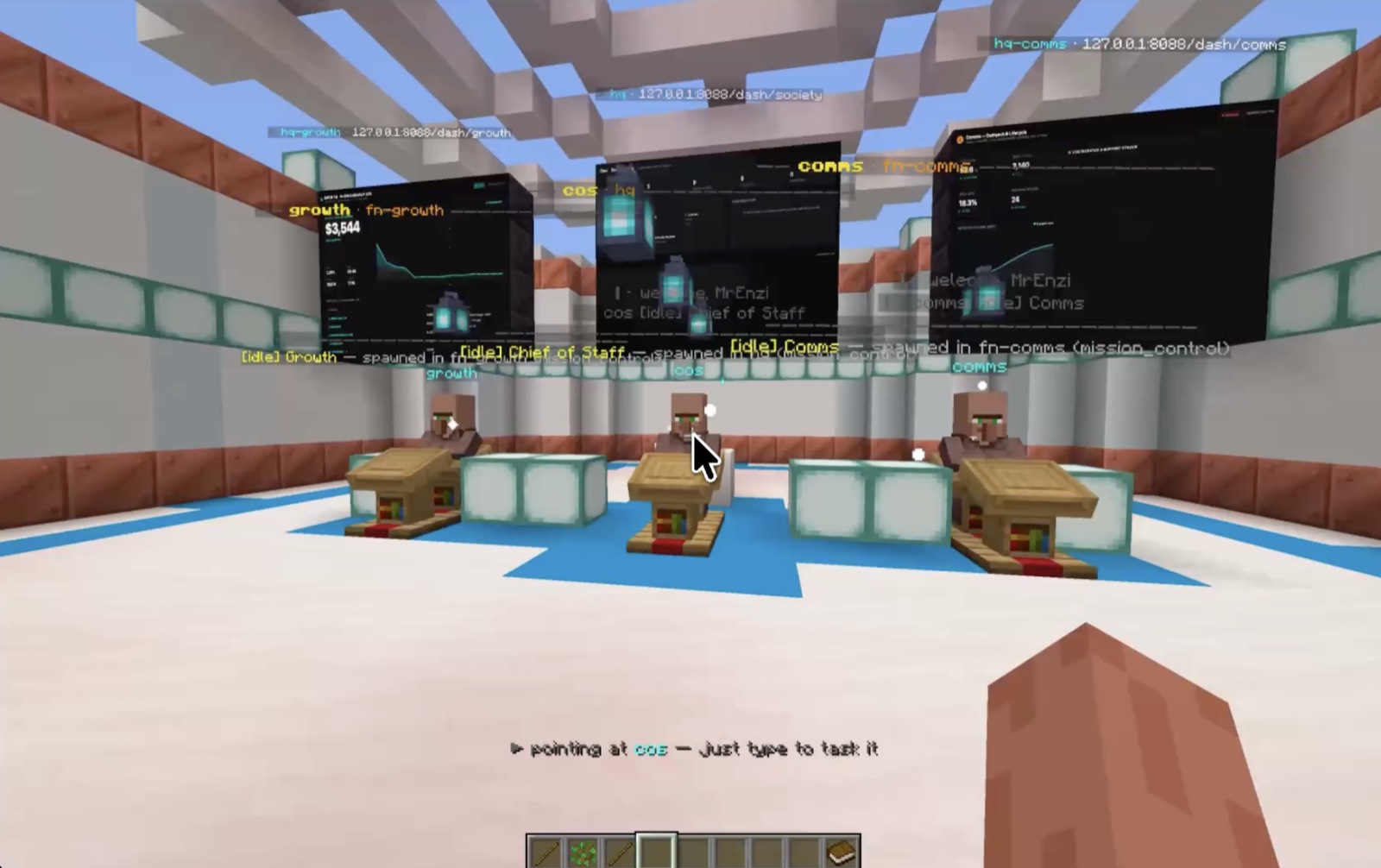
THREE STATIONS, ONE PROJECT — built for three people to stand, talk, and code at once. The screens behind each desk are the agents thinking, live.
🖥 ONE SHARED COMPUTER — its screen is the wall, facing everyone
todo-app
building live · one machine · one source of truth
Station 1 · Ana
◆ Claude Code + screen
▸ raw terminal
✦ Hermes + screen
🌐 web browser
Station 2 · Ben
◆ Claude Code + screen
▸ raw terminal
✦ Hermes + screen
🌐 web browser
Station 3 · Cy
◆ Claude Code + screen
▸ raw terminal
✦ Hermes + screen
🌐 web browser
THE WHOLE PITCH, AS A DIFF
Same goal — ship together. One of these is all overhead.
Read it like a code review. The
− red lines are what GitHub makes you do. The
+ green lines are what AgentJam does instead.
how it feels to ship together
⊟ GITHUB
⊞ AGENTJAM
The unit of work
A branch you have to merge back
One shared computer — nothing to merge
Review
Open a PR · wait · ping · wait
Walk over · watch it happen · talk
Staying in sync
pull / fetch / rebase / pray
Always on the same version, by default
Two people, one file
Merge conflict — someone referees
…nothing. You both just see it change
Feedback speed
Hours to days
The same second
Presence
A green dot in Slack
You see them — standing right there
When it breaks
"works on my machine"
One machine. It works, or it doesn't
How you drive it
Type git incantations
Talk. The agents build.
⚡ No branches / PRs / merges
You're always on the same version, so there's nothing to reconcile. The merge dance just… disappears.
👀 Review is live
Walk over, watch, talk. No queue, no waiting on a click, no "LGTM" three days late.
🎙 Voice-first
You see who's working on what, and you talk your code into existence — together, in one room.
STRAIGHT TALK — WHAT THIS IS AND ISN'T
We didn't delete Git. We deleted the dance.
⚠ what "no GitHub" really means
No day-to-day branch / PR / merge ceremony — not deleting git forever. You can still push now and
then to back up or ship a release. The thing we remove is the friction that only exists because you were apart.
▸ who it's for
Big async teams still want pull requests, and that's fine. AgentJam is for people who want to build in the
same room — roll it out across a company so every team shares a computer, or just spin one up
with friends from a laptop and code together on a Saturday.
The infrastructure already exists — the coding office, the terminals, the AI agents, the voice, the browser
on the wall. The new piece is the one-computer layer: everyone reaching into the same
machine, so a whole team builds one project at once.
START YOUR FIRST JAM
Your next project doesn't need a single pull request.
Your team and one shared computer. One live project
you build together — seeing each other's changes appear, talking it into existence. If it feels like
"we're building this, right now, together," it's working.
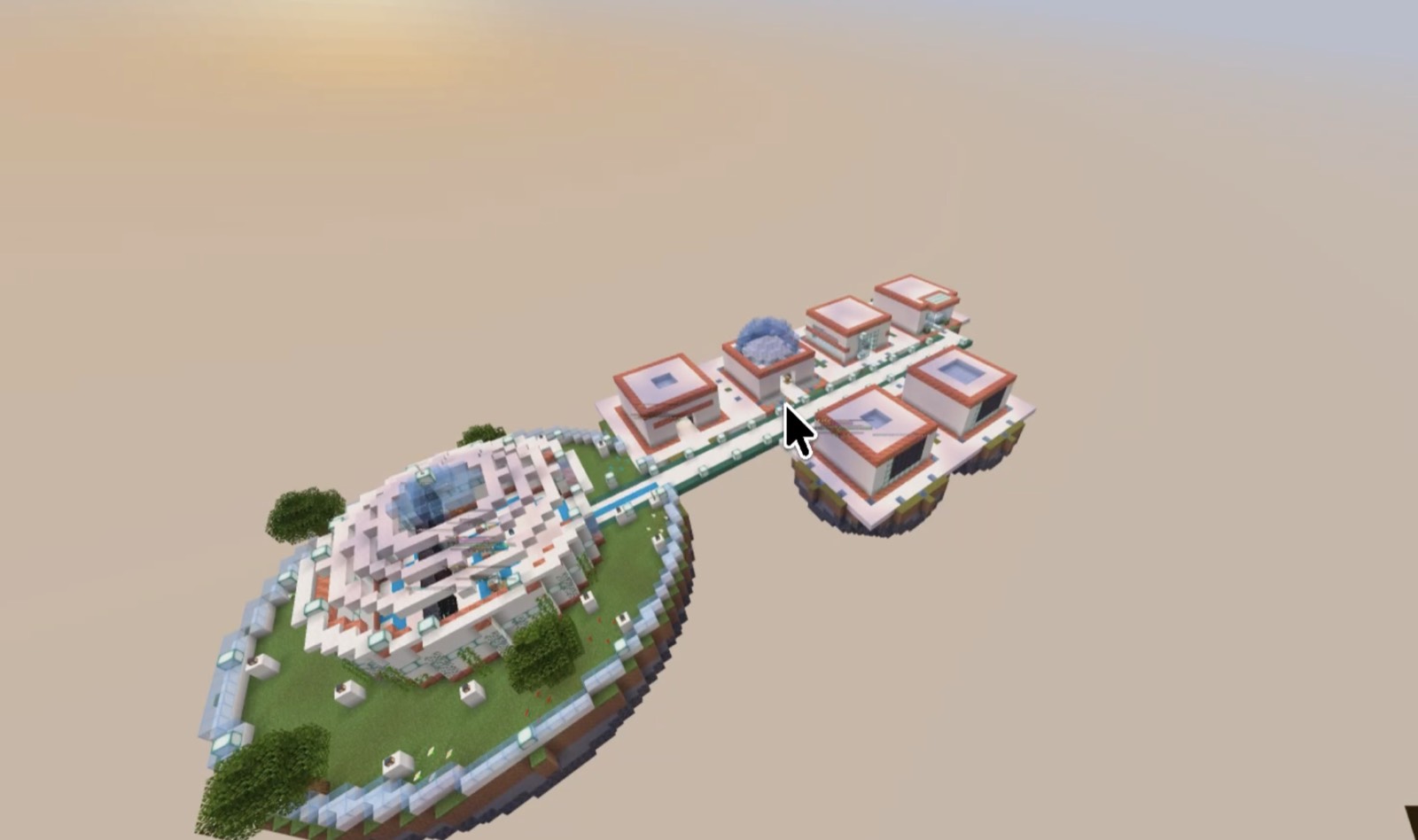
ONE WORLD, AT GOLDEN HOUR — your whole team on one island, one computer, building one thing. No branches between you. Just the world.
your terminal — one command
# stand up one shared computer everyone codes on$ ./agentjam build// one machine · stations for the whole team▸ world ready · one computer · 0 conflicts · invite your team▍